Back in September I was early for a dentist appointment, the kind of early where you end up flicking through whatever’s on the waiting room table. It was the August issue of British Vogue, open to a feature on fat liberation, and it stopped me enough that I photographed the pages so I wouldn’t lose the thread and could read it properly later. The title caught my eye: The Aspirational Fat Woman Has Quietly Disappeared by Gina Tonic. It also brought me straight back to something I think about a lot in my work: why women avoid being photographed, sometimes for years.
The piece traced something I hadn’t properly sat with before. Body positivity started as a genuinely political movement, back in 1967 when 500 people gathered in New York’s Central Park to burn diet books and eat ice cream in protest against the shame attached to fat bodies. Decades later, fashion and wellness brands packaged it, sold it and made it briefly mainstream. For a few years, as the writer put it, fat women “were no longer hidden or shown only as cautionary tales. We were aspirational. Stylish. Sexy. Confident.”
Then the mood shifted again. Weight-loss drugs arrived, and she watched many plus-size influencers turn into weight-loss influencers instead: “The aspirational fat woman has quietly disappeared and in her place is the woman documenting her transformation away from fatness. The ‘before’ and ‘after’. The shrinking body. The ‘health journey’.”
Reading it, what struck me wasn’t the fashion cycle of it, though that’s real too. It was how conditional the whole thing had always been. These women never simply had visibility: it was granted, then quietly withdrawn, depending on what was selling that year.
A photographer’s take on the same problem
I’d already been sitting with a similar idea, from a book by Teri Hofford called The Geode Theory: Chipping Away At Body Image. Teri is a photographer too, which is probably why it landed the way it did. Her idea is that body image work isn’t about fixing anything. It’s about chipping away, slowly, at the insecurity sitting on top of you, until what’s underneath gets a chance to show. I love that there’s no before and after in her version at all, only less and less in the way.
I first read The Geode Theory in 2024 and went back to it this summer, and I recommended it in my July newsletter too. The idea at its heart is simple and quietly radical: the problem was never our bodies. What changes over time is not us losing our shine, but life adding layers of pressure, comparison and grey over something that was always there. Teri writes about how that inner sparkle doesn’t disappear with hardship, it becomes stronger and more defined because of it, and that reconnecting with it just takes attention, reflection and time. Hard work, but worth it. If you’ve ever put off a photo until you felt better about your body, this is the book I’d put in your hands.

That’s the opposite of the shift the Vogue piece describes, and exactly what Gina Tonic is pushing back against. The culture she writes about says you earn the right to be seen by changing your body until it fits whatever’s currently in fashion. Teri’s idea is about noticing that you were always fine underneath, and that the insecurity was the thing added on, not the body itself.
I think this is part of why I photograph the way I do, without props, without distraction, just the person exactly as they are. So much of what we call self-improvement is really an attempt to sand down the very things that make us who we are. My work is to help women see their own shine again, not add a new one.
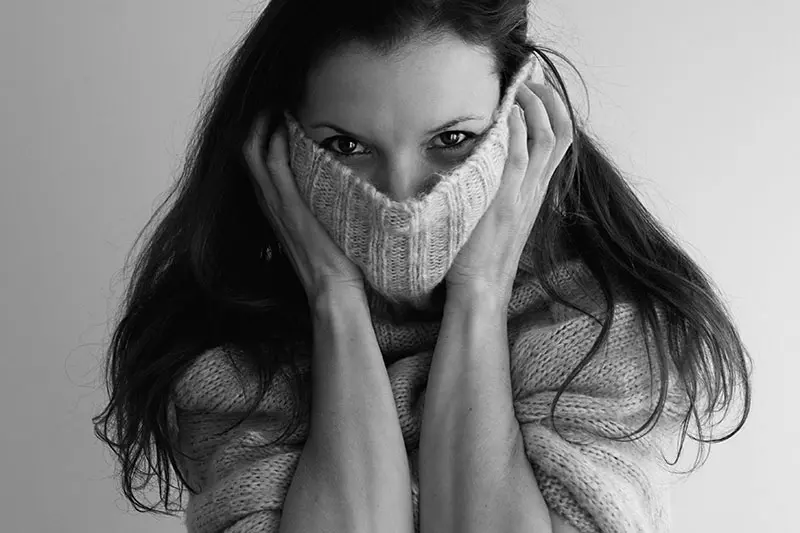
It’s also why, during lockdown in 2021, I turned the camera on myself. For years I’d listened to mums talk about their weight, and watched some of them step out of the photos with their children because they felt they weren’t good enough to be in them. I wanted to put myself in the shoes of the women in front of my lens, and feel what they feel. At the time I described it as being naked with just a light cover on, looking for a beam of light somewhere in the distance. This photo is from that series, and I haven’t retouched it. It’s my body as it is, and it’s allowed to be seen too.

By the way, Teri is a body image activist, and she empowers women with a compassion I’d love to bring to my own work too. I’d also love to photograph her next time she’s in London, so Teri, if you’re reading this, consider it an invitation!
Why women avoid being photographed, and who decides you’re “allowed”
I hear a version of this constantly in my work, and I think it’s the real answer to why women avoid being photographed for years at a time. It comes up most with women who book an Empowering Women Portrait Session. Most of them have spent years photographing everyone else, their kids, their partners, their friends, and have almost no recent photos of themselves. Somewhere along the way they decided their body wasn’t the kind people should be looking at: too big, too old, or simply out of step with whatever the culture happened to be rewarding that year. I wrote recently about my own version of this, and my mum’s, in Your Changing Body, Seen Kindly.
The Vogue piece isn’t about photography at all, but it makes one thing obvious: the standard moves. It went from diet culture to body positivity and back again within the writer’s own adult life, from growing up in the noughties to now, and none of those women’s bodies changed anywhere near as fast. If you’re waiting for your body to become the “right” kind before you’ll let yourself be photographed, you’re waiting on a target that was never going to hold still. It has been moving for a lot longer than that, too, as I found when I looked back at the female body in art history.
I don’t think the answer is waiting for permission, mine or the fashion industry’s or anyone else’s. I think it’s what Teri’s book gets at: there’s nothing to fix first, only something to chip away at, until you can see what was always there.
An invitation, not a wait
So many women avoid being photographed until they’ve reached some finish line that keeps moving. You don’t need to be smaller, younger, or further along in some transformation before you’re allowed in front of the camera. That was never really true, for anyone, at any point in the history this article traces. What you need is someone willing to actually look, properly, at what’s already there.
If you’re ready to stop waiting to be the “right” kind of visible, I’d love to hear from you.
The book link above is an affiliate link, so if you buy through it I may earn a small commission, at no extra cost to you.