
Three weeks in my lovely mountain village in the Italian Alps. For those of you who are curious, it’s Altopiano di Asiago. Three weeks of endless family meals, impromptu gatherings with old friends, and the kind of deep conversations that happen when you’re sitting around a table long after the dishes should have been cleared or the evening playing cards. It wasn’t the traditional holiday of spa days and quiet beach reads. It was full-on Italian family time, complete with all the beautiful chaos that brings.
For the first time in years, I completely switched off. No Instagram stories documenting my morning espresso, no curated posts about mountain views. I checked emails sporadically, trusting that 17hats, my CRM was handling the important stuff (thank goodness for systems that work while you sleep, right?).
But here’s the thing about truly disconnecting: coming back feels like navigating an odd limbo. The sandals are back in the cupboard, replaced by proper shoes and the weight of responsibility. My brain is caught somewhere between still-on-holiday mode and shouldn’t-I-be-doing-something-right-now?
If you’ve ever felt that post-summer re-entry challenge, you’re definitely not alone. Coming back to business after summer doesn’t have to feel like jumping off a cliff into cold water. Instead of diving back in on autopilot, what if we approached this transition with intention? What if we used this moment to reset with purpose rather than just catching up?
Here are seven ways to ease back into business mode while actually improving how you work.
1. Start Small: Clean Your Creative Space
There’s something almost magical about a clean workspace. When I walked into my studio after three weeks away, it felt like visiting a friend I hadn’t seen in too long. But like any good reunion, it needed a bit of preparation first.
I’m not talking about a complete overhaul – I left it nice and clean after all – just a gentle reset. I spent 30 minutes tidying up, lighting a candle, refilling tea bags and wiping down surfaces. Those wraps that had been “temporarily” placed on the chair? Finally found their way back to their proper home.
Starting with your physical space does something powerful for your mental space. It’s like your workspace is saying, “Welcome back, I’m ready when you are.” There’s psychology behind this: when our environment feels organised, our minds follow suit. The clutter isn’t competing for our attention anymore.
Try this: give yourself just 15 minutes to tidy your main work area. Not a deep clean, not a complete reorganisation, just a friendly welcome-back gesture to yourself. You’ll be amazed how this small act can shift your entire mindset about getting back to work.
2. Pause and Evaluate Before You Accelerate
Here’s where most of us go wrong: we jump back into everything exactly as we left it, without asking whether it was working in the first place. It’s like getting back on a bike without checking if the wheels are properly aired.
Before you start spinning those plates again, take a moment to evaluate. What was working well before your break? What felt like you were pushing a boulder uphill? Sometimes distance gives us clarity that being in the thick of things doesn’t allow.
I sat with my notebook and asked myself some honest questions: Which client projects energised me? Which marketing strategies actually brought in business? Which daily habits made me feel productive versus just busy? The answers weren’t always what I expected.
This isn’t about judging yourself harshly, it’s about being kind enough to yourself to make conscious choices instead of defaulting to autopilot. Create a simple list: keep doing, stop doing, start doing. Sometimes the most productive thing you can do is decide what you’re not going to do anymore.
3. Reconnect with Your Creative Practice
Here’s something I’ve learned: creativity isn’t a luxury for business owners, it’s fuel. When we reconnect with our creative practices, we’re not taking time away from business. We’re investing in the part of ourselves that makes our business unique.
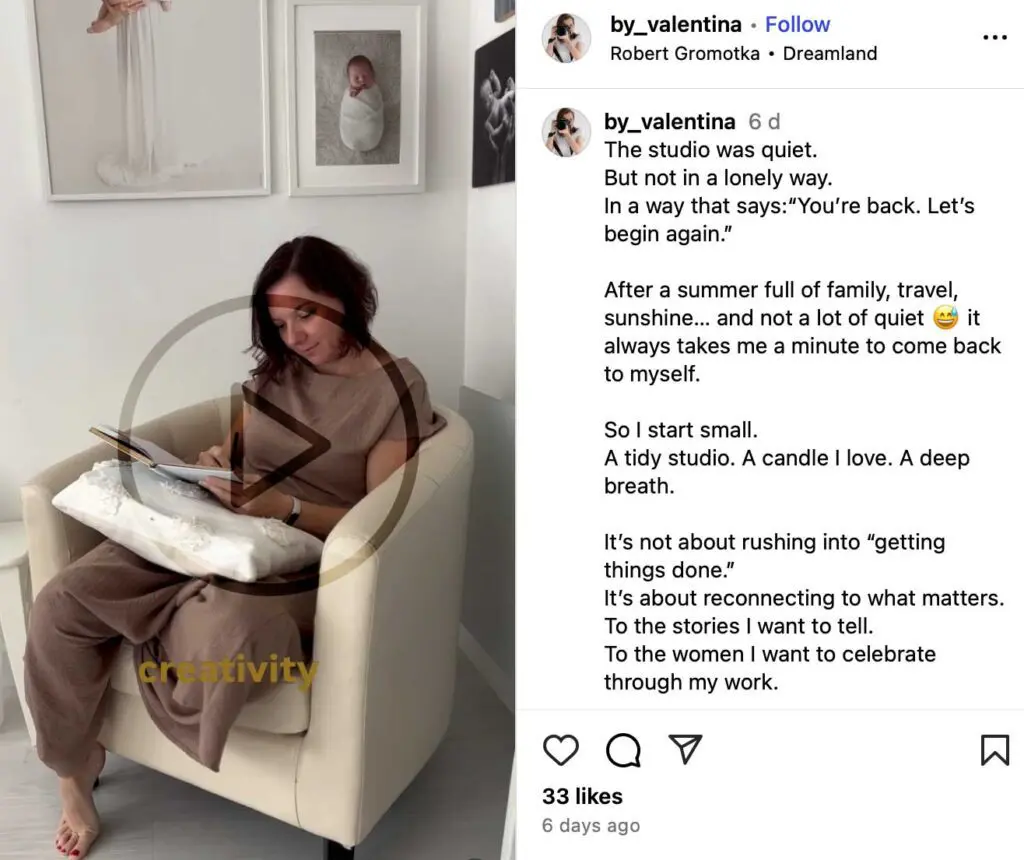
After three weeks of not writing, picking up my journal felt like greeting an old friend. The first few entries were rusty, but gradually, the thoughts began to flow. There’s something about putting pen to paper that processes experiences in a way that thinking alone can’t achieve.
I also started taking quick self-portraits again before seeing clients. It might sound silly, but there’s something powerful about this ritual. It’s like saying “hello, welcome back” to myself. These aren’t meant for social media, they’re purely for me, a way of checking in and feeling present.
Your creative practice doesn’t have to be elaborate. Maybe it’s five minutes of sketching, humming while you make coffee, or arranging flowers from your garden. The key is consistency, not perfection. When we feed our creativity, it shows up in everything we do, from problem-solving to client interactions to innovative solutions.
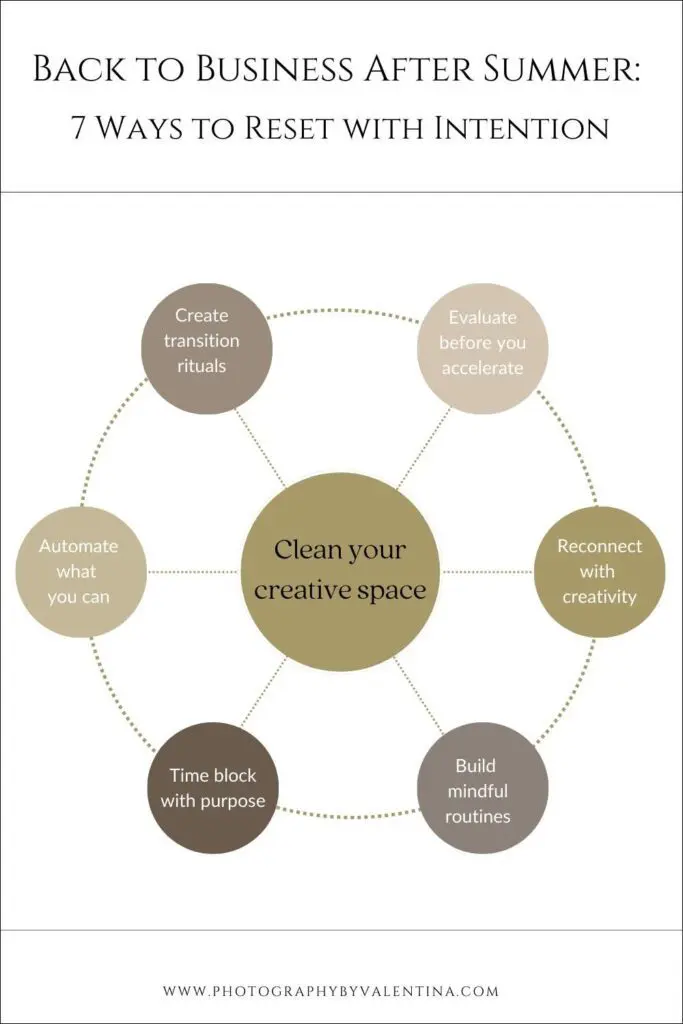
4. Rebuild Mindful Routines
I’ve been taking morning walks for years now, partly because I have a dog who gives me those expectant looks, and partly because I genuinely love starting my day outside. Even on holiday in Italy, those walks happened (though they involved considerably more chat and coffee – or prosecco, depending on the time – stops than usual).
But here’s what I realised: while I’d maintained the physical routine whilst I was away, I’d lost the mindful part. Those walks had become automatic. Coming back, I decided to reclaim them as meditation time.
Related article: Embracing Mindfulness and Photography: Lessons from My Morning Walk
Plus I’m also adding those crucial 5-10 minutes of quiet time that I didn’t made space for back in Italy, but I love taking for myself, especially before my newborn photography session. It’s incredible how those few minutes or sometimes just a few deep breaths create a new reset for the day.
Routines aren’t just about productivity; they’re about creating anchors in your day that remind you to be present. What routines did you maintain over summer? Which ones serve you, and which ones could use a mindful refresh?
5. Time Blocking with Purpose
One thing that became clear during my digital detox was how scattered my attention had become. Without the constant ping of notifications, I remembered what it felt like to focus on one thing at a time. Coming back, I was determined not to lose that clarity.
Time blocking isn’t a new concept, but doing it with intention makes all the difference. Instead of just scheduling tasks, I started blocking time for different types of thinking. Creative time in the morning when my mind is fresh. Administrative tasks in the afternoon when my energy naturally dips. Client calls and appointments when I’m most present and engaging.
The key is treating these blocks as sacred. When it’s creative time, I’m not answering emails. When it’s email time, I’m not trying to be creative. This might seem rigid, but it’s actually incredibly freeing. Your brain doesn’t have to constantly switch gears, wondering what it should be focusing on.
Start with just one thing. Pick your most important work and give it undivided attention for a set period. No phone, no other tabs open, no multitasking. You’ll be surprised how much you can accomplish when you’re truly present.
Related article: The Power of Digital Minimalism: Why Less Screen Time Means More Life
6. Automate What You Can (and Then Breathe)
One of the best business resets is simplifying the way you work.
Can we talk about systems for a moment? Because honestly, my CRM (17hats) was my daily saviour before my trip, and coming back, I appreciated it even more. Knowing that client enquiries were being responded to, appointments were being managed, and nothing was falling through the cracks gave me the freedom to actually disconnect.
But automation isn’t just about big systems. It’s about any process you can set up once and let run without your constant attention. I spent a day planning and scheduling my social media posts for the month. Not because I don’t want to be spontaneous, but because having a foundation in place means I can add spontaneity without the pressure of starting from scratch each day.
Look at your regular business tasks and ask: what could run without me? Maybe it’s email templates for common enquiries, automated appointment reminders, or batch-creating content. The goal isn’t to remove yourself from your business, but to free up mental space for the work that truly needs your unique attention.
If you’re interested in exploring what 17hats can do for you, take advantage of my 17hats 50% discount for the first year.
Related article: From Chaos to Control: How a CRM System Transforms Your Business
7. Create Rituals for Transition
Those self-portraits I mentioned earlier? They’ve become more than just a creative exercise, which of course as a portrait photographer, are important to grow and experiment. But they’re a ritual that helps me transition from personal mode to professional mode. It’s my way of saying “welcome back to myself” before I welcome clients into my days.
Rituals create consistency and intention in ways that routines alone can’t. While routines are about efficiency, rituals are about meaning. They mark transitions, create mindfulness, and help us show up more fully for whatever comes next. Another one for me is writing.
Maybe your ritual is making a special cup of tea before starting work, taking three deep breaths before opening your laptop, or writing down one thing you’re grateful for. It doesn’t have to be elaborate, it just needs to signal to your brain that you’re shifting gears intentionally.
I’m working on closing rituals like tidying my desk before ending the workday, writing tomorrow’s top three priorities, or simply saying “thank you” to my workspace. I feel these small acts help me transition out of work mode as intentionally as I transition in.
Finding Your Rhythm Again
Coming back to business after summer doesn’t have to feel jarring. Instead of forcing yourself back into old patterns that may not have been serving you anyway, use this transition as an opportunity to be more intentional about how you work.
You don’t have to implement all seven strategies at once, that would be the opposite of starting small. Pick two or three that resonate most with you right now. Maybe it’s cleaning your workspace and adding those five minutes of quiet time. Or perhaps it’s time blocking and reconnecting with a creative practice that’s been neglected.
The goal isn’t perfection; it’s presence. It’s about creating a business rhythm that feels sustainable rather than frantic, intentional rather than reactive. Because at the end of the day, the best business reset isn’t about working harder, it’s about working with more awareness and purpose.
What’s one small step you can take today to reset with intention? Your future self (and your business) will thank you for it.
Related article: Small Business Essentials: Tools I Use Every Day to Stay on Track