What Milk Tales Revealed About Breastfeeding and Mental Health

I didn’t write Milk Tales: a Journey of Motherhood and Breastfeeding because I had the perfect breastfeeding story.
I wrote it because I didn’t.

My own journey into motherhood, and into breastfeeding, was messy, emotional, full of doubt, and laced with moments of deep connection. It was also lonely most of the times, confusing, and far from the serene, glowing images we often see in books or on screens. Those early days were so painful that it brings tears to my eyes 14 years later just talking about it.

Related article: Why I Wrote My Breastfeeding Book

When I started this project, I wanted to photograph the journey of breastfeeding. But what I uncovered, what mothers offered me, was so much more. They gave me their truths. Their raw, vulnerable, resilient truths.

And at the heart of so many of these stories was one recurring thread: breastfeeding and mental health.

Cover of Milk Tales book by Valentina Rebeschini, reflecting themes of breastfeeding and maternal mental health

The Unseen Layer of Breastfeeding

When we talk about breastfeeding, we often reduce it to a binary: breastfed or not, successful or not, natural or not. But what we rarely talk about, truly talk about, is the emotional toll it can take.

For some, it brings joy and connection. For others, grief, shame, or a lingering sense of failure.

Many mothers in Milk Tales shared that they didn’t feel seen when things were hard. They didn’t know if what they were feeling was “normal.” They carried questions like:

  • Why am I crying while feeding my baby?
  • Why does this feel so overwhelming?
  • Am I the only one who feels like this?

The answer, of course, is no. You’re not the only one. And you’re not alone.

Science Confirms It Too

Research supports what so many mothers have told me through their tears and their laughter:

  • Postpartum depression affects about 1 in 10 women, according to NHS
  • Postnatal anxiety is even more common, affecting 1 in 5 women
  • Hormonal shifts after birth can intensify emotional sensitivity.
  • The stress of breastfeeding challenges like pain, low supply, latch issues, can fuel anxiety, shame, and guilt.

In short, breastfeeding and mental health are deeply connected.

This doesn’t mean that breastfeeding causes mental health struggles. But it does mean that the experience, however it unfolds, can impact how we feel, how we see ourselves, and how we navigate early motherhood.

Related article: Turning Up the Volume on Maternal Mental Health

What the Stories Revealed About Breastfeeding and Mental Health

One mother shared how painful latch issues brought her to tears, but so did the unexpected beauty of quiet moments in the middle of the night.
Another described the bittersweetness of feeding one baby while holding the memory of another.
Another admitted she thought about quitting every single day but kept going, not out of pressure, but because it brought her a moment of calm in the chaos.

There were stories of pain and healing. Of milk soaked with memories of miscarriage or trauma.
Some stories were filled with guilt. Others, with joy.
Many carried both.

They spoke of feeling overwhelmed, unseen and also strong, proud, deeply connected.

These stories were layered. Tender. Sometimes messy. Often contradictory.

And that’s what makes them so powerful.

Quotes from Milk Tales: Real Mothers Share Their Breastfeeding and Mental Health Struggles

If You’re Struggling with Breastfeeding and Mental Health

This is your reminder:

You’re allowed to feel joy and grief at the same time.
You’re allowed to love your baby and not love breastfeeding.
You’re allowed to change your mind.
You’re allowed to ask for help.
You’re allowed to stop. Or keep going. Or do both in different seasons.

You are not failing.
You are not alone.
You are not broken.

The Power of Storytelling

One thing I’ve learned from Milk Tales is how healing it can be to simply be heard.

When a mother shares her story, she takes back her power.
She gives others permission to be honest, too.
She creates space for healing her own and someone else’s.

That’s why I believe stories are a form of care.
A form of connection.
A form of quiet revolution.

Related article: The Power of Breastfeeding Stories: How Sharing Your Journey Helps Others

You might be interested in: The Breastfeeding Stories We Don’t Tell (And Why We Should)

If you’ve read Milk Tales and it resonated, thank you.
If you’ve shared it, reviewed it, or recommended it to a friend, thank you.

And if you haven’t read it yet, but this post touches something in you… I’d love for you to explore the book. Not because I want you to buy it. But because maybe, just maybe, it will remind you that your story is valid too.

Milk Tales is available on Amazon and you can read more about it on my website.

If you feel called, I’d love to hear your own story, too.
There’s room for all of it.
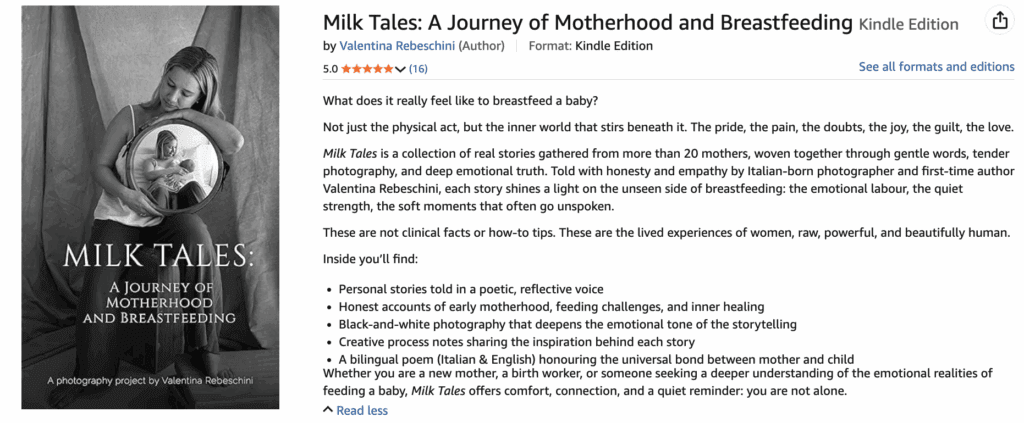
Milk Tales book on Amazon – A Journey of Motherhood and Breastfeeding by Valentina Rebeschini, featuring emotional stories and photography about breastfeeding and maternal mental health

Follow Me

There is something special that happens when you hold a printed album for the first time.

Its weight. 
The texture under your fingers. 
The sound of the pages turning. 
The way the images look back at you, solid and real, in a way a screen never quite manages.

A digital file exists somewhere. 

A printed album IS somewhere. You can feel the difference.

This is a maternity album. Leatherette cover, gold embossed text, lay flat pages that let every image breathe. 

It is the final chapter of a session, the moment everything we created together becomes something you can live, enjoy and pass down.

This is why, after a shoot, a printed product is never an afterthought for me. It is the whole point.

And it is also why I am not the right photographer for everyone. If you are looking for a gallery of just digitals and nothing more, I would gently point you elsewhere. 

But if you want something you can hold, something that feels like it truly exists, something your child will one day open and say this was us, then we should talk.

Maternity photography in Richmond and Twickenham.
After 15 years, so much of what I do is on autopilot.

I look for the gorgeous light and read the baby. I know when to wait and when to act. And I do it without thinking.

But the moment someone is beside me, watching, learning, everything slows down. I have to find words for things I stopped noticing years ago. And in doing that, I remember how it felt at the beginning. The insecurities. The fear of getting it wrong. The weight of feeling like you should already know. The comparison with others.

Teaching reminds me how much courage it takes to learn something new and how gently we should treat ourselves while we do.

If you are starting out, in any field, well done. Truly. I know how hard and lonely those first steps can be. But you don’t have to take them alone.

And if you are a photographer thinking about a one to one newborn training day in my Twickenham studio,I would love to be part of your journey.
Link in bio.
Six weeks ago I shared a glimpse behind the scenes of this session. Today, you get to see what we made.

She arrived with her props already chosen.

Nude stockings. The kind her mother wore. The ones women mended rather than replaced.

She knew exactly what she wanted to say. 
My job was simply to hold the space and let her say it.

This is what a portrait session can be. 
Not a makeover or a way to fit an idea of beauty. But a conversation between a woman and her own story, made visible.

Dyana is an artist, activist and doula. She explores identity, the body, and everything that lives between and beyond definition.

I am grateful I had the chance to photograph her.
Tomorrow I have a newborn session and a 1:1 training day with a photographer travelling from Switzerland to spend the day with me.

But before any of that, the work had already started.
It starts with a conversation. Learning about your birth, your family, how things have been since you came home. Then comes the studio prep, making sure the space is warm, clean and ready for someone very new to the world, with attention to every small thing that makes a family feel safe and held.

After 15 years, this is still how I do it. Every time.
That same care is what I pass on when I teach.

If you are a parent looking for a photographer who takes this seriously, or a photographer thinking about training, this is what I stand for.

📩 Links in bio for both.
She almost didn’t come.

She told me she wasn’t feeling confident. 
That she didn’t know how to pose. 
That maybe I should photograph someone else.

I hear this more than you’d think. From women who are more reserved and introvert but also the ones who are funny and so alive in person. Women who have simply spent too long seeing themselves in a fixed way.

We spent a morning together. Just her, the light, and a space where nothing needed to be fixed or hidden.

The woman in these photos? She was there all along.

If you’ve been telling yourself a similar story, I’d gently ask you this: what if you’re wrong too?
facebook icon
pinterest logo

VALE@PHOTOGRAPHYBYVALENTINA.COM

07577 978246

LONDON NEWBORN & MATERNITY PHOTOGRAPHER

Based in Richmond, I work with families across London to capture life’s most meaningful milestones through portrait photography.