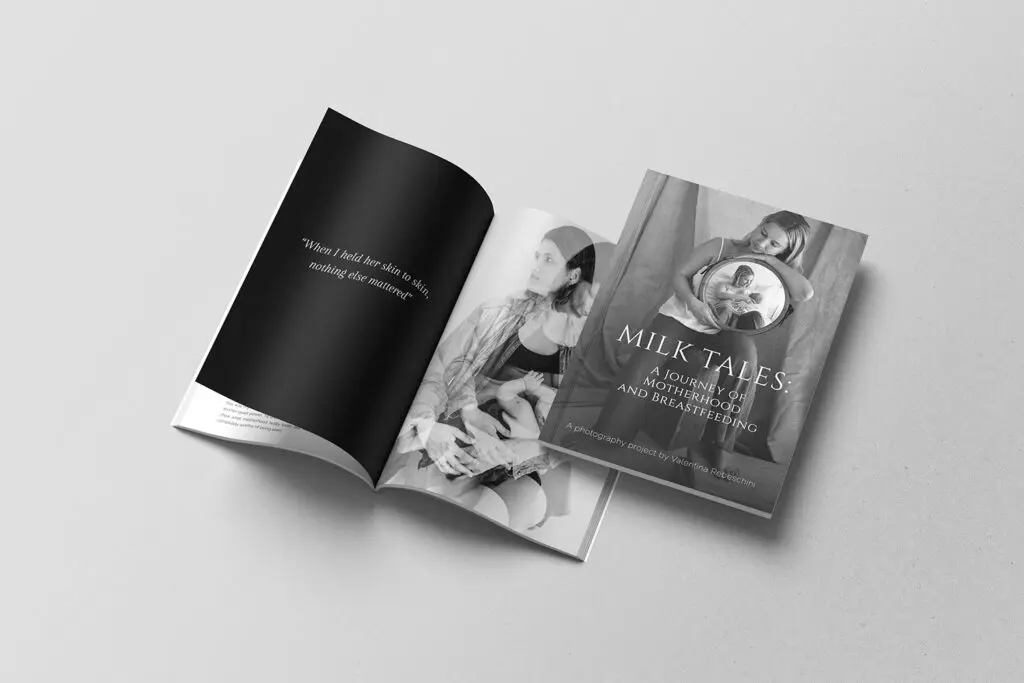
When I saw my work featured in Grazia, I felt something shift. Not just the pride of seeing Milk Tales recognised, though that was real and precious. It was the knowledge that this conversation about breastfeeding difficulties, the one I’d been so desperate to have fourteen years ago, was finally happening in spaces where mothers might stumble upon it when they need it most.
The article is called ‘Photographing 25 New Mothers Helped Me Come to Terms With My Breastfeeding Guilt‘, brilliantly written by journalist Mel Hunter who believed in this project and helped bring it to a wider audience. But what strikes me most isn’t my own story within those pages. It’s knowing that somewhere, a mother might read it while sitting in the dim light of a 3am feed, tears streaming, wondering if she’s the only one who feels this broken.
She isn’t. And that’s exactly why these stories matter.

The Silence Around Breastfeeding Difficulties
We’re told that breastfeeding is natural. As if our bodies should simply know what to do, as if struggle indicates failure rather than the complex reality of what breastfeeding actually is.
The statistics tell a different story. Studies consistently show that breastfeeding difficulties are incredibly common. Problems with latching, painful or cracked nipples, mastitis, low milk supply, tongue tie. These aren’t rare complications. They are experiences shared by countless mothers. Yet somehow, we still carry these difficulties in silence, each of us believing we’re alone in our struggle.
The UK has one of the lowest breastfeeding rates in the world. While 81% of mothers start breastfeeding (from the 2010 Infant Feeding Survey, which is the last UK-wide survey), only around 1% exclusively breastfeed to six months as the World Health Organisation recommends. These aren’t just numbers. They’re stories. They’re the mother with cracked, bleeding nipples who was told it was just baby blues. The woman with an undiagnosed tongue tie whose baby couldn’t latch. The mother whose milk didn’t come in as expected, who felt her body had betrayed her.
These are breastfeeding challenges that deserve to be spoken about, not hidden away.
What Happens When We Break the Silence
Creating Milk Tales taught me something unexpected. As I photographed each mother, as I listened to their stories, I began to understand that my experience wasn’t a personal failure. It was part of a much larger pattern, one that had been kept quiet for far too long.
There was Sara, whose story echoed parts of mine so closely that I cried. Not just for her, but for both of us, for all the years we’d each carried that pain alone. And the idea of the crying eye image was born. There was Annie, who breastfed her second son while carrying the memory of her firstborn, Louie, who had passed away at seven months. There was Barbora, feeding her toddler in a café while an older woman told her it was off-putting.

Each story was different. Some spoke of pain, others of judgement. Some mothers found breastfeeding blissful, while others battled through mastitis, tongue tie, or the exhaustion of feeding around the clock. But what united them was this: they all needed to tell their story. They all needed to be witnessed.
When we share our breastfeeding experiences, something profound happens. The mother who felt alone discovers she isn’t. The woman who blamed herself begins to understand the systems that failed her. The isolation starts to lift.
Related article: Why I Wrote My Breastfeeding Book
The Weight of “Breast is Best”
Public health messaging around breastfeeding often centres on one simple phrase: breast is best. It’s meant to encourage, to inform mothers of the benefits. But for those of us who struggle, those three words can feel like judgment. Like proof of our inadequacy.
I remember the weight of that message in those early weeks with my daughter. After a smooth pregnancy and empowering water birth, I felt strong. Then breastfeeding became agony from the first hour. Hundreds of needles spearing my breast. Cracked, bleeding nipples. My baby drinking my blood with her milk.
The health visitors who came to my home put it down to post-partum blues. They seemed almost deaf to my descriptions of physical pain. Only when Amy began losing weight did they diagnose nipple thrush and suggest formula. My husband couldn’t get to the chemist fast enough.
I needed help, not a reminder that breast was best. I needed someone to say, “This isn’t working, and that’s okay. Let’s find another way.” I know the benefits of breastfeeding are real, both for mother and baby. But the messaging often feels like all or nothing, leaving no room for the middle ground where so many of us find ourselves. And breast is not always best if it’s breaking you, if it’s affecting your mental health during a stage when you’re already emotionally fragile.
Moving Past Breastfeeding Challenges
Fourteen years later, I can say that creating Milk Tales was an act of healing. Not just for me, but I hope for other mothers too. The book isn’t about whether breastfeeding is good or bad. It’s about the painful, complicated, deeply personal reality of it.
Some women in Milk Tales fed for months, others for years. Some eventually found joy in it, others relief and sadness when it ended. What matters isn’t how long they breastfed or whether they used formula. What matters is that they were honest about their experience and that they felt seen.
The Grazia feature means this conversation is reaching further. It means more mothers might discover they’re not alone. It means we’re slowly, collectively, beginning to talk about breastfeeding challenges and difficulties with the honesty they deserve.
If you’re reading this while struggling with feeding, please know: you are not failing. Your body is not broken. Breastfeeding challenges can be complex, difficult, and lonely. Whatever you’re feeling, whether it’s pain or guilt or grief or relief, it’s valid. You’re doing the best you can with what you have, and that is enough.
Perhaps you’ll find yourself in the pages of Milk Tales. Perhaps you’ll simply find a moment to breathe, knowing that somewhere, another mother understands.
That’s why we tell these stories. Not to convince anyone of anything, but to offer what I so desperately needed all those years ago: the simple, powerful knowledge that you are not alone.
Milk Tales: A Journey of Motherhood and Breastfeeding is available on Amazon.
Read the full Grazia feature here.