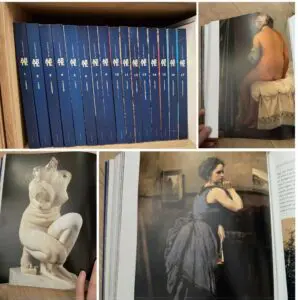
This summer I spent some time looking at the female body in art history, with a collection of art books I bought myself when I was about 14 or 15. I’m buying so many books lately, but that’s another problem. What I wanted from these ones was slowness: actual pages, no screen, nothing suggesting what to look at next.
I wanted to see how women’s bodies had been looked at, and if I’m honest, I wanted to get more comfortable with my own. What I found was thousands of years of people deciding what a woman’s body should look like, then changing their minds.
A woman who fits in your hand
One of the oldest bodies in the story is the Venus of Willendorf, a limestone figure about 11cm tall, carved roughly 25,000 to 30,000 years ago and found in Austria in 1908. She has a round belly, heavy breasts, wide hips and no face. The name “Venus” came much later. Nobody knows what she was really called, or what she was for.

Venus of Willendorf. Photo: Bjørn Christian Tørrissen, CC BY-SA 4.0
We often read that she was a fertility goddess, but that’s an educated guess. Professor Viren Swami points out that when food was scarce, carrying more weight may have helped health and fertility. Others have wondered if figures like her were made by women looking down at their own bodies. I love that idea, though no one can prove it.
Whatever she meant, someone looked at a body like that and decided it was worth carving. I find that moving. It’s a very old answer to every woman who has ever held a cushion over her stomach in a family photo.
Goddesses could be naked, real women had to stay unnoticed
The next stop for the female body in art history is the Hellenistic world, the Greek centuries after Alexander the Great. While reading an essay on the subject by Victor Szepessy, three things stopped me.
The first is that these statues were almost certainly made by men. The ideal woman was a man’s idea from the very start.
The second is who got to be seen. Only goddesses, usually Aphrodite, were shown naked in monumental sculpture. Mortal women were carved clothed, and praised in writing for their chastity, modesty, obedience and, my personal favourite, “inconspicuous behaviour”. I wrote recently about the bodies we’re taught are “allowed” to be seen. It turns out that’s a very old conversation.
The third is the story of the painter Zeuxis, who is said to have created his Helen of Troy by choosing features from five different girls and combining them. So the most beautiful woman in the world was a body no real woman had. We have an app for that now.
Even then, the ideal wasn’t as fixed as it looked. Most Aphrodites of the time followed one refined model, but the Crouching Aphrodite has a voluptuous figure and “fleshy folds around the midriff”. A goddess with a soft stomach, carved in marble and admired for over two thousand years. I’d have loved her in my studio.
A Venus who couldn’t stand
Being Italian, I could hardly write about the female body in art history and skip the Renaissance. In the Gothic centuries before it, the ideal woman had heavy hips, a large belly and thin shoulders, and then the fashion for ancient statues turned her into a fleshy hourglass. So the Greeks were shaping women’s bodies all over again.
The painting everyone knows is Botticelli’s The Birth of Venus, from the mid-1480s. She arrives from the sea on her shell, and if you look at her hands you’ll see the Greeks are still with us. Botticelli borrowed them from the Venus Pudica, the “Venus of Modesty”, a classical type of statue where the hands cover the breasts and groin. So even at the moment she’s born, the goddess of beauty is already being inconspicuous.
Then look at the rest of her. Her neck and body are too long, and her weight sits so far over her left leg that she couldn’t hold that pose. Like Zeuxis’s Helen, she has a body no real woman had. She’s one of the most famous women in art, and she couldn’t actually stand like that.
Round, soft and full of life
The bodies real women were meant to aim for looked more like Titian’s Venus Rising from the Sea, painted around 1520. Professor Jill Burke describes the ideal as “hairless, with plump limbs and stomach but small, improbably circular, breasts”. A little roundness was something to want, and “fat” could even be a compliment, but the real aim was balance, neither too thin nor too fat.
Painters went on filling their canvases with full, round women, Rembrandt and Rubens among them, and in that world fullness could read as health and plenty. Women were painted carrying babies and feeding them, a story I explored in Breastfeeding in Art History. Those are the images I think of when I remember that a body was once allowed to look as if it had done something.
I don’t want to romanticise it, though. Art historians still argue over how much the Rubens woman was what everyone wanted, and how much she was what Rubens wanted. The brush was nearly always in a man’s hand, and a woman could be painted as soft and abundant while having very little say over her own life.
Burke’s point is that real women worked hard to shape their bodies into forms dreamt up by male writers, painters and poets. Beauty was also one of the few things that gave women any control over their lives, so I can’t judge them for trying. A kinder standard is still somebody else’s standard.
Then the female body in art history started to shrink
By the late 1800s the ideal was slight, with a tiny corseted waist and delicate feet. According to Swami, that body signalled frailty, subservience, status and moral virtue, which tells you plenty about what was being asked of women.
In the 1920s the corset gave way to underwear that bound the breasts flat for a boyish shape. Extreme dieting came with it, which surprised me so soon after a war. In 1926 a fashion for “non-sugar” diets was even blamed for a world sugar glut, and by 1927 the British Medical Association was issuing warnings about thyroid tablets taken to lose weight. The first weight-loss adverts appeared too, and there were rolling devices such as the Punkt Roller, which promised that 10 minutes of “gentle kneading” from its rotating rubber cups could replace two hours of exercise. Once a body could be printed and put in front of millions of women, it could also be sold to them, and I’ve written about the film studios’ part in that in Why Am I Not Photogenic?
Then came Twiggy in the 1960s, and by the mid-1990s the ideal sat at what Swami calls “clinically underweight levels”. In that same decade as Twiggy, 500 people gathered in Central Park to burn diet books and eat ice cream. Their idea became body positivity, which was later packaged, sold and, in the weight-loss drug era, quietly taken back.
The female body in art history never held still
So there it is, in one long breath: rounded, refined, soft, frail, flat, thin, toned, thin again. Each one the right body, for a while. And in every one of those eras, there were real women looking at themselves and feeling they’d got it wrong.
I find this oddly comforting. Somewhere in those thousands of years, your exact body was the ideal. Quite possibly in limestone.
It also makes one thing very clear to me. The standard has moved so many times that it can’t be telling us anything true about our bodies. It only tells us about the moment we happen to be living in, and about who was holding the chisel.
Standing on the plinth
Looking at the female body in art history did something I didn’t expect. It made me want to see my own body that way. So I stood on a plinth with my camera and started taking photos, with different angles and different types of movement.
Most of them are still files on my computer. One became a print.
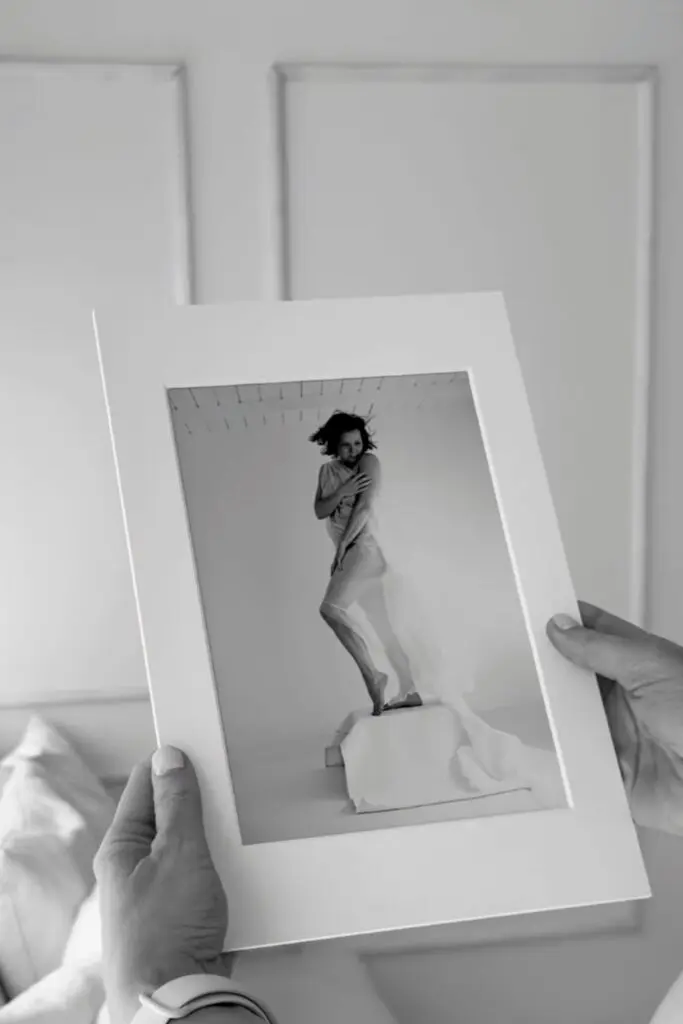
I wasn’t trying to copy a statue. I was trying to feel at home in my own body, the way those figures seem to feel in theirs. None of them looks as if she’s waiting to lose half a stone first.
“I need to hide my tummy”
A lot of women tell me they need to lose some weight before they get in front of my camera. Or they’ll do it next year, once things calm down, once they feel more like themselves. I understand that completely, and I wrote about my own version of it, and my mum’s, in Your Changing Body, Seen Kindly.
They’re in good company. In 1499 the Italian art patron Isabella d’Este apologised to the Duke of Milan for the portrait she’d sent him, because it made her look a bit fatter than she was. He replied that perhaps she had got fatter. She was about 25, and more than 500 years later I still hear the same worry in my studio, in words like “I need to hide my tummy”.
The best time is always now
But I’ve now turned enough pages on the female body in art history to say this with some confidence: you can’t catch a standard that has been moving for thousands of years and is still moving now. In my own lifetime it has gone from the very thin nineties to the curves of the 2000s, then to strong and athletic, and the weight-loss drugs are already pulling it back the other way. It’ll have moved again by the time you get there, and the years you spent waiting won’t be in any photo.
Someone once took a piece of stone and decided a real woman’s body was worth their time. That’s all I’m trying to do in my Empowering Women Portrait Sessions: look at you properly, as you are now, at this age, in this body.
So I’ll leave you with the question I asked myself on that plinth. When did you really look at your own body, not to change it, but to understand it?
If you’d like someone to look with you, I’d love to hear from you.