
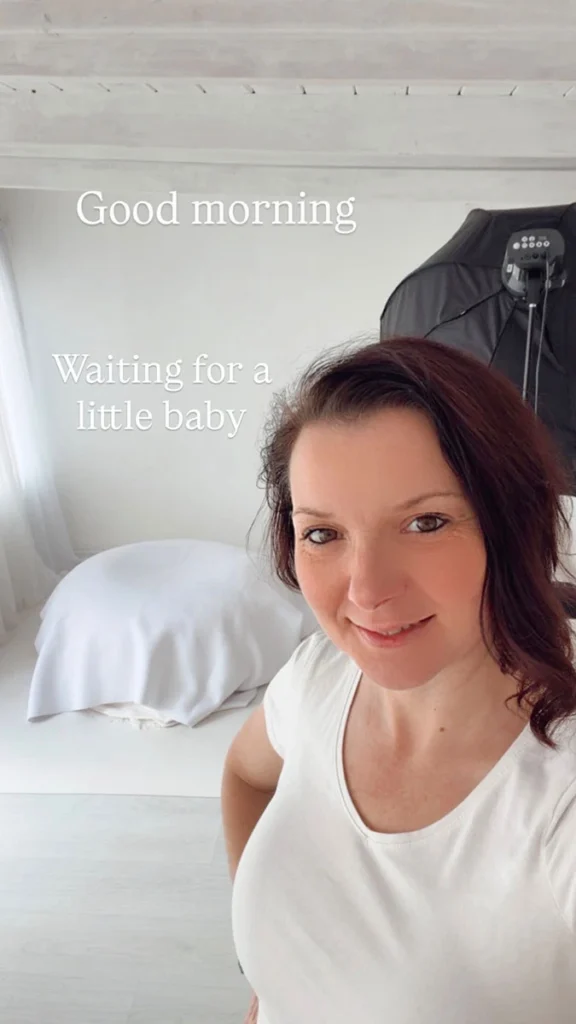
Personally, I don’t take many selfies, but when I do, it’s usually one of two things. In my studio, phone up for a quick Instagram story to say here I am, this is where I’m working or what I’m doing today. The only purpose of this is simple and straightforward self-promotion, and I don’t mind saying so. The other occasion is at a particular event or with friends, something I want to remember, and also want the people to see. The first one usually gets deleted after being posted as they don’t have much value. The second one might be shared or not and kept or not depending on the event.
If you’ve ever asked yourself why do we take selfies in the first place, especially past a certain age, I don’t think it’s what we assume. It’s rarely about looking good. Or at least, neither of mine are. One is a small piece of marketing. The other is for a memory.
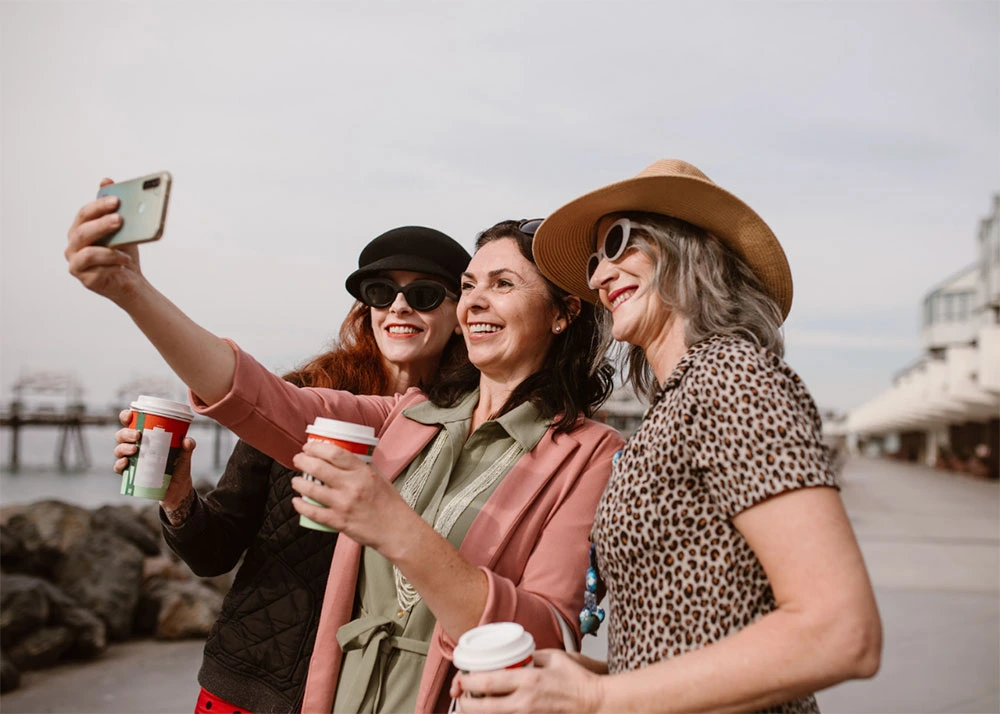
What a selfie is actually for
For a lot of women my age, mid-40s, I think this is closer to the truth than we admit. When we do reach for the phone, it’s rarely to check how we look. In the studio, it’s practical, marking that I’m here, I’m working, no need to dress that up as anything more meaningful than it is. At an event, it’s different again, it’s for the memory itself, and for sharing that memory with the people who were there, or the ones I wish had been. Neither one is vanity. Neither one is really about my face at all. But this is my point of view and how I see it.
So I asked. I ran a little poll on my Instagram stories, and 60% of the people who answered said they take selfies, 40% said they don’t. Then I asked why. Every single person who answered picked the same reason: to remember a moment. Not one chose “to see myself”. It’s a small, informal poll, not a study, and I suspect the people who mostly take selfies for work didn’t vote. But it said exactly what I’d been thinking.
That’s different, I believe, from why a lot of younger women take selfies. There’s a whole other, very real use of the selfie built around wanting to look a certain way, curated, chosen, filtered until it says something specific about who you are. That’s not what I’m writing about here. I can only really speak to my own experience, and to what I see in women around my age. For us, most selfies aren’t planned. They’re closer to a note to self, or a note to someone else, than a self-portrait.
That word matters, actually. I’d rather make a self-portrait than take a selfie, if I’m honest. A self-portrait is planned. Thought through. I’m not grabbing whatever’s in front of me, I’m trying to say something, or work something out. That’s not narcissism either, if anything it’s closer to the opposite. It’s a way of learning something about myself, or sitting with a feeling long enough to actually look at it, rather than reaching for the phone and moving straight on.
A phone in your hand, seeing differently
I recently watched this TEDx talk by Linda Hudson, called Exposing “the Selfie.” She talks about watching her students take selfies constantly, and instead of dismissing it, she found something almost hopeful in it. Her argument, roughly, is that the urge behind a selfie is old. Older than phones, older than cameras. The same instinct that made someone press a painted hand against a cave wall: I was here, this mattered. Which validated what I said above. She also makes the point that once you’re in the habit of looking, even at yourself, you start noticing more, not less.
There’s a small study that backs up my studio/event split in an interesting way too. Researchers interviewing young adults in India in 2024 found that selfie-taking was mostly about preserving a memory (“it’s for keeping memories alive,” one participant said), while selfie-posting was more about staying connected to friends and family, or managing how others saw them. Different acts, doing different jobs, even though it’s the same phone and the same second.
I’m not sure either source is the whole story for how I use selfies, but I like that framing more than the usual one. It treats the impulse as human and social, not vain. Even Will Storr’s book Selfie, which I expected to be all about selfies, turned out to be about the self, and how much of it is shaped by what we imagine other people think of us.
Then we look back with a different pair of eyes
Here’s the part I think is actually worth saying out loud. In the moment, taking that studio selfie or that photo at the party, I’m not thinking about how I look. That’s not what the photo is for. But scroll back to it a few days later, and suddenly I’m not looking at a record of where I was, or who I was with. I’m looking at my face, critically, the way I’d never have looked at it while actually taking the photo.
That’s the mismatch. The photo was never trying to be flattering. It was trying to say I was here, or look what we got up to. But once it exists, we judge it against a completely different standard, one it was never built for, and then feel disappointed when it doesn’t hold up. It got me too at first. Now, if the photo was only for a marketing story, it’s deleted straight away, rather than going through the Spanish Inquisition a week later. My brain doesn’t need that kind of useless self-sabotaging.
There’s research that lines up with this too. A 2024 study looking at selfie habits found that the act of taking and posting a selfie was linked to feeling fine about your appearance, while it was specifically the editing afterwards, going back in and adjusting, smoothing, choosing, that was linked to feeling worse. It’s not the taking that does the damage. Apparently, it’s what happens once we start scrutinising it after the fact.
I recently wrote about why I hate photos of myself, and I think this is really the same problem, just showing up somewhere else.
A snapshot, a selfie, a photo someone catches of you mid-laugh, none of them were ever trying to be your best angle. They were trying to catch something true. The disappointment only shows up once we hold them to a standard they were never aiming for.
Why do we take selfies? Letting the photo be what it’s for
So maybe the answer isn’t to take better selfies, or fewer of them, or to be kinder to ourselves in them, although that wouldn’t hurt. Maybe it’s to stop asking a documentation photo to do a portrait’s job.
A selfie says I was here, or this is for you. That’s enough. It was never meant to hold up under scrutiny, because scrutiny was never the point.
A proper portrait is the opposite kind of photo. It’s not grabbed in a second, it’s made, with time, with someone else’s attention on you, aimed at showing you something closer to how you actually look and are, not just a flipped phone screen held at arm’s length. That’s a different job entirely, and it’s the one I do.
If your selfies have been making you feel like you don’t photograph well, that might be worth questioning.
They were never trying to show you that in the first place.
If you’d like to find out what a photo taken with real attention actually shows you, I’d love to hear from you.