
This summer, just before World Breastfeeding Week, I reached out to the Breastfeeding Network with a story about what happens when breastfeeding hurts. I wasn’t sure anything would come of it, but a few weeks later they came back and asked if I’d write a piece for their newsletter, BfN News.
Writing for BfN felt different from writing for my own blog. Their readers aren’t only mothers. They’re also the volunteers, peer supporters and breastfeeding counsellors who sit with mothers in those first hard weeks. The people I needed most fifteen years ago, and didn’t know how to find.
Back then I was the mother feeding every hour, cracked and bleeding, mostly convinced I was failing. If you’d told me I’d one day write about it for a breastfeeding charity, I’d probably have cried. To be fair, I cried at most things back then (and also now!).
I had 400 to 500 words, which for me is a real challenge. So I chose the one thing Milk Tales taught me more clearly than anything else: when breastfeeding hurts, it’s rarely only your body that’s struggling. There’s a second struggle underneath, and we almost never talk about the two together.
Here’s the piece as it appeared in the September 2026 issue.
Originally published in BfN News, September 2026 (Issue 98), by the Breastfeeding Network.
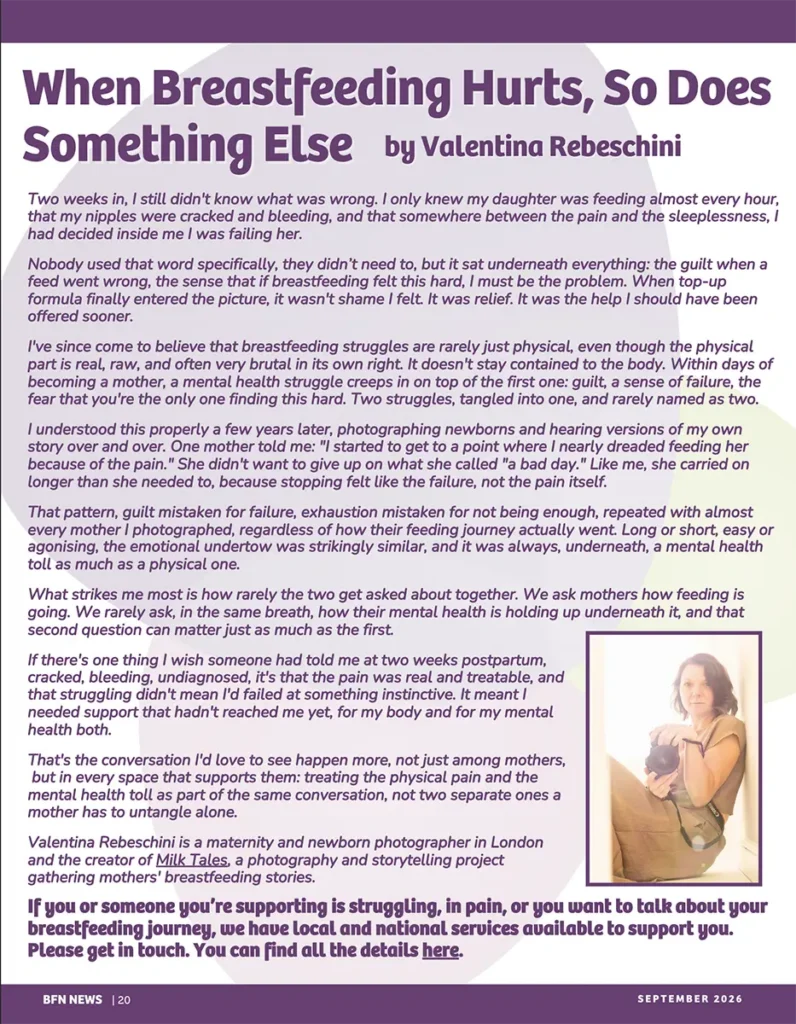
When Breastfeeding Hurts, So Does Something Else
Two weeks in, I still didn’t know what was wrong. I only knew my daughter was feeding almost every hour, that my nipples were cracked and bleeding, and that somewhere between the pain and the sleeplessness, I had decided inside me I was failing her.
Nobody used that word specifically, they didn’t need to, but it sat underneath everything: the guilt when a feed went wrong, the sense that if breastfeeding felt this hard, I must be the problem. When top-up formula finally entered the picture, it wasn’t shame I felt. It was relief. It was the help I should have been offered sooner.
I’ve since come to believe that breastfeeding struggles are rarely just physical, even though the physical part is real, raw, and often very brutal in its own right. It doesn’t stay contained to the body. Within days of becoming a mother, a mental health struggle creeps in on top of the first one: guilt, a sense of failure, the fear that you’re the only one finding this hard. Two struggles, tangled into one, and rarely named as two.
I understood this properly a few years later, photographing newborns and hearing versions of my own story over and over. One mother told me: “I started to get to a point where I nearly dreaded feeding her because of the pain.” She didn’t want to give up on what she called “a bad day.” Like me, she carried on longer than she needed to, because stopping felt like the failure, not the pain itself.
That pattern, guilt mistaken for failure, exhaustion mistaken for not being enough, repeated with almost every mother I photographed, regardless of how their feeding journey actually went. Long or short, easy or agonising, the emotional undertow was strikingly similar, and it was always, underneath, a mental health toll as much as a physical one.
What strikes me most is how rarely the two get asked about together. We ask mothers how feeding is going. We rarely ask, in the same breath, how their mental health is holding up underneath it, and that second question can matter just as much as the first.
If there’s one thing I wish someone had told me at two weeks postpartum, cracked, bleeding, undiagnosed, it’s that the pain was real and treatable, and that struggling didn’t mean I’d failed at something instinctive. It meant I needed support that hadn’t reached me yet, for my body and for my mental health both.
That’s the conversation I’d love to see happen more, not just among mothers, but in every space that supports them: treating the physical pain and the mental health toll as part of the same conversation, not two separate ones a mother has to untangle alone.
If you’re struggling right now
If breastfeeding hurts for you right now, or for someone you’re supporting, you don’t have to work it out alone.
The Breastfeeding Network has local drop-in groups and national support. You can find a drop-in centre near you here, or call the National Breastfeeding Helpline on 0300 100 0212.
More stories from Milk Tales
This piece grew out of Milk Tales, my book of photographs and stories from 24 mothers about what breastfeeding really asks of us. If you’d like to read more:
What Milk Tales Revealed About Breastfeeding and Mental Health
The Breastfeeding Stories We Don’t Tell (And Why We Should)
Why I Wrote My Breastfeeding Book
Milk Tales was also featured in Grazia, where I talked about how the project helped me come to terms with my own breastfeeding guilt.
When breastfeeding hurts, the pain is real. So is the second struggle underneath it, and neither one means you’re failing.